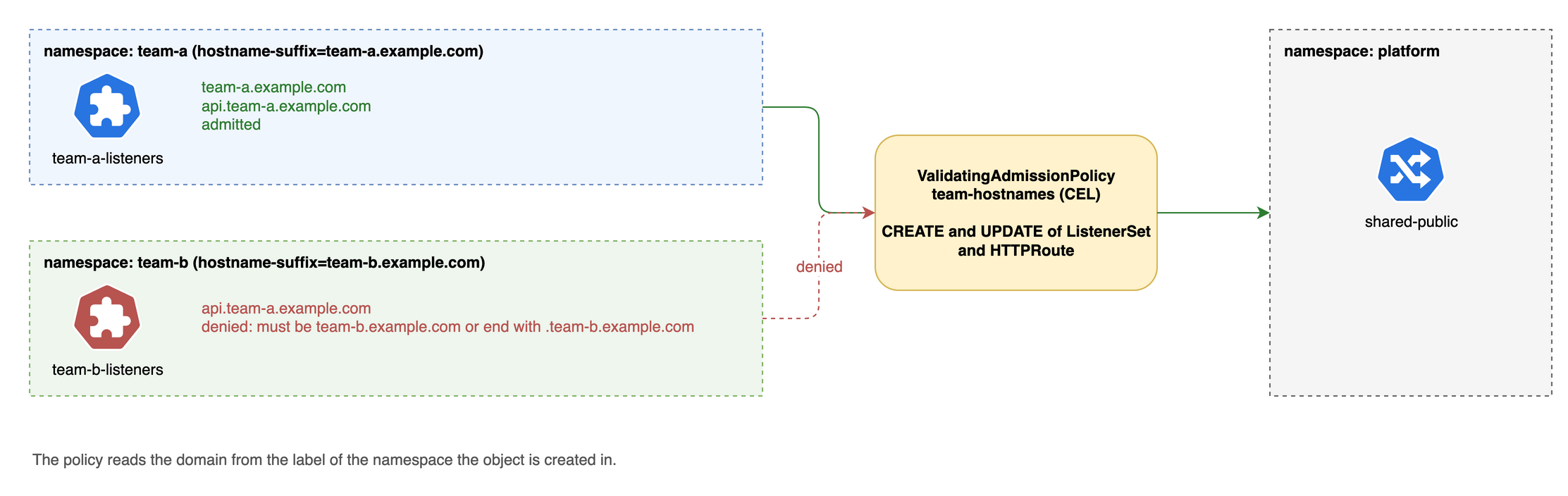
In my last post a platform team owns the Gateway and every application team attaches its own ListenerSet and HTTPRoute. The only control the platform team has is allowedListeners, which selects namespaces. Once a namespace is allowed, it can claim any hostname.
A conflict is contained, but nothing stops team-b from creating a listener for api.team-a.example.com. This post closes that gap with a built-in Kubernetes feature: a ValidatingAdmissionPolicy (CEL).
The full manifests are in hostname-policy/ of the demo repo.
Setup
You need Kubernetes 1.30 or newer (ValidatingAdmissionPolicy is GA) and the Gateway API standard CRDs v1.5 or newer, which include ListenerSet. The policy only looks at API objects, so no gateway controller is required.
The idea
Each team namespace gets a label with the domain it owns:
apiVersion: v1
kind: Namespace
metadata:
  name: team-a
  labels:
    hostname-suffix: team-a.example.com
The policy reads that label through namespaceObject and checks every hostname in ListenerSet and HTTPRoute objects:
apiVersion: admissionregistration.k8s.io/v1
kind: ValidatingAdmissionPolicy
metadata:
  name: team-hostnames
spec:
  failurePolicy: Fail
  matchConstraints:
    resourceRules:
      - apiGroups: ["gateway.networking.k8s.io"]
        apiVersions: ["v1"]
        operations: ["CREATE", "UPDATE"]
        resources: ["listenersets", "httproutes"]
  variables:
    - name: suffix
      expression: "has(namespaceObject.metadata.labels) && 'hostname-suffix' in namespaceObject.metadata.labels ? namespaceObject.metadata.labels['hostname-suffix'] : ''"
    - name: hostnames
      expression: >-
        object.kind == 'ListenerSet'
          ? object.spec.listeners.map(l, has(l.hostname) ? l.hostname : '')
          : (has(object.spec.hostnames) ? object.spec.hostnames : [''])
  validations:
    - expression: "variables.suffix != ''"
      message: "namespace has no hostname-suffix label, so it may not define hostnames"
    - expression: "variables.hostnames.all(h, h == variables.suffix || h.endsWith('.' + variables.suffix))"
      messageExpression: "'hostname not allowed in this namespace, must be ' + variables.suffix + ' or end with .' + variables.suffix"
A missing hostname becomes an empty string, so it fails the check. That matters because a listener or route without a hostname would match everything. The binding applies the policy to all namespaces except the system ones and platform:
apiVersion: admissionregistration.k8s.io/v1
kind: ValidatingAdmissionPolicyBinding
metadata:
  name: team-hostnames
spec:
  policyName: team-hostnames
  validationActions: ["Deny"]
  matchResources:
    namespaceSelector:
      matchExpressions:
        - key: kubernetes.io/metadata.name
          operator: NotIn
          values: ["kube-system", "kube-public", "kube-node-lease", "platform"]
The suffix check uses '.' + suffix, so evil-team-b.example.com does not pass as a match for team-b.example.com.
Result
Team-a can use its own domain, including a wildcard inside it (*.team-a.example.com). Everything else is rejected at admission time:
| Case | Result |
|---|---|
ListenerSet in team-b with api.team-a.example.com | denied |
ListenerSet in team-b with *.example.com | denied |
| ListenerSet without hostname | denied |
ListenerSet with evil-team-b.example.com | denied |
| ListenerSet in a namespace without the label | denied |
HTTPRoute in team-b with api.team-a.example.com | denied |
| HTTPRoute without hostnames | denied |
| UPDATE of team-a’s ListenerSet to a team-b hostname | denied |
Show output
$ kubectl apply -f 20-valid.yaml
listenerset.gateway.networking.k8s.io/team-a-listeners created
httproute.gateway.networking.k8s.io/team-a-route created

$ kubectl apply -f denied/01-listenerset-foreign-hostname.yaml
The listenersets "b-uses-a" is invalid: : ValidatingAdmissionPolicy 'team-hostnames' with binding 'team-hostnames' denied request: hostname not allowed in this namespace, must be team-b.example.com or end with .team-b.example.com
Alternative: Gatekeeper
On AKS the Azure Policy add-on brings Gatekeeper, so the same rule can be written in Rego (hostname-policy/gatekeeper/). It gave the same decisions in the namespaces it covers. The differences:
| ValidatingAdmissionPolicy | Gatekeeper (Azure Policy add-on) | |
|---|---|---|
| Rule language | CEL | Rego |
| Deploy | kubectl apply | Azure Policy custom definition and assignment. A direct ConstraintTemplate is rejected (This cluster is governed by Azure Policy). Sync took about 15 minutes. |
| Domain per team | Namespace label, read via namespaceObject | One assignment per team with namespaces and suffix parameters. The Rego input has the namespace name but not its labels, and reading them needs data replication, which the Gatekeeper docs warn can hit race conditions. |
| Namespace without setup | Denied | Allowed |
| Existing objects | Not checked | Audited every 60 seconds by default, shown in the constraint status and as Azure Policy compliance |
Gatekeeper fits if you already govern with Azure Policy and want reporting on existing objects. For this one rule the VAP is shorter, applies immediately and needs no per-team assignment.
Limits
- The VAP only validates
CREATEandUPDATE. Objects that already exist are not checked, so apply it before you onboard teams or review existing ones. Gatekeeper’s audit covers that. - The label is the source of truth. Whoever can edit the namespace labels can change the allowed domain, so keep that permission with the platform team.
- Two teams with overlapping suffixes are not prevented. Hand out distinct domains.
- Paths are not covered. The same approach is possible with
HTTPRoute.spec.rules[].matches[].path, but it is harder: a route without matches defaults to/and catches everything, regular expressions can’t be checked and a prefix check must respect whole segments (/team-amust not allow/team-a-admin).
Takeaways
allowedListenerscontrols who may attach. It does not control what they claim. A ValidatingAdmissionPolicy covers the second part with a few lines of CEL and no extra component.- Deny a missing hostname explicitly, otherwise a catch-all slips through.
- Keep the rule next to the namespace: one label per team is easy to review in GitOps.